

The following article was written by Gulf Coast Community Foundation and appeared on Sarasota Magazine’s website on October 27, 2025.
Behind a colorful mural honoring America’s servicemen and women, a new story is unfolding – one of hope, home, and healing. At Heroes’ Village, veterans once living in tents or shelters now wake up to quiet mornings, friendly neighbors, and the steady comfort of a door that locks and a light that switches on.
Heroes’ Village is a newly built affordable housing community designed exclusively for veterans, a place where compassion has taken shape in brick and mortar. Brought to life through generous philanthropists, local government and private partners including St. Vincent de Paul CARES, it stands as a testament to what’s possible when a community comes together to care for those who once served us. In honor of Veterans Day, we spoke with three residents whose stories reflect both the struggles they’ve overcome and the stability they’ve found at Heroes’ Village.
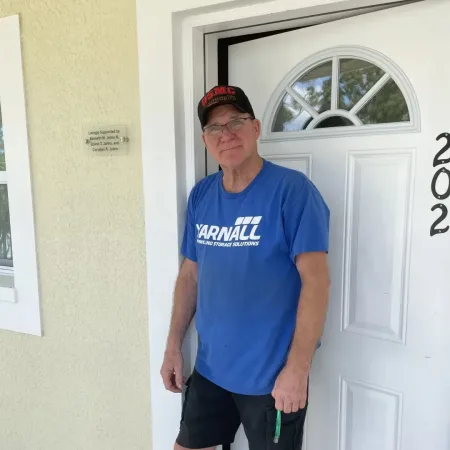
Jeff Hein, 63, is a Marine Corps veteran originally from Buffalo, NY. He joined the military at 17 with the dream of becoming a New York State Trooper. After four years of service, he left his hometown in search of warmer temperatures and began a career in construction. He settled permanently in Sarasota in 2018, where he continued working in construction through a season of transition before finding Heroes’ Village.
“I lived under a palm tree in a tent for 3 weeks. I needed a solid home base that I knew I could come home to every day, have a roof over my head, a clean bed, a place to do laundry, and go to work the next day. In that regard, [Heroes’ Village] gave me a solid platform to build off of. This place is fantastic. To where I work, it’s an eight-minute bike ride. I was living at The Salvation Army, and as soon as I showed up [to Heroes’ Village], I was in 110%.”
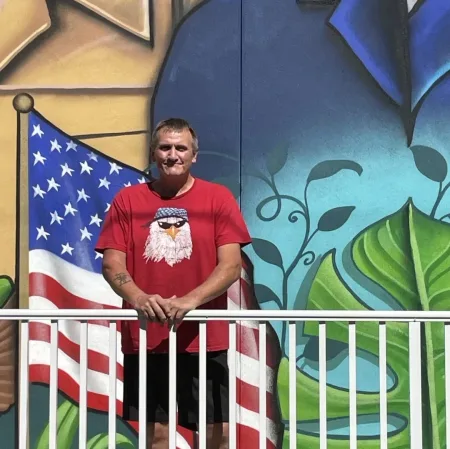
Steven Mitchell, 58, is a Marine Corps veteran originally from Connecticut who served almost four years in the military. Since moving to the Sarasota area in 2009, he has worked in the construction industry, specializing in carpentry. Earlier this year, he was forced to leave his recovery residence in Bradenton when it became condemned. He turned to The Salvation Army to help find him a new home, which led him to Heroes’ Village.
“It brought tears to my eyes, ain’t going to lie. I had just been struggling at having housing for a while now. I’ve got a lot of demons and I just had been struggling for a long time. [Heroes’ Village] is a beautiful place. Having the time to not have to worry so much about rent and bills and everything has enabled me to concentrate on finally finding something that’s a career. And on top of that, taking care of my health… normally that’s impossible.
[It] gives me the possibility to finally get ahead in life. That’s pretty much what life is all about.”

Paul-Stephen Varszegi, 66, is a Marine Corps veteran originally from Budapest, Hungary. He and his parents settled in Fairfield, Connecticut in 1967. A severe neck injury during his first year of training sent him home for spinal fusion surgery. He moved to Sarasota in 2000 and is a dedicated volunteer with the US Veterans’ Rowing & Kayaking Foundation. Prior to finding a new home at Heroes’ Village, he was run over by two cars that left him permanently disabled and in and out of the hospital for almost a year.
“Doctors told me I had 5 more surgeries in 30 days. I [was] transferred to the VA hospital at Bay Pines for nine months. While I was there, I read about Heroes’ Village opening up in Sarasota, so I decided [with] my social worker that we would apply. I got approved after one month. I was very grateful, because truthfully, I didn’t have any place to go. [Heroes’ Village has] given me a sense of peace knowing that I have a stable place to live and that I don’t have to worry about not knowing where I’m gonna be tomorrow. I could be homeless and I don’t know how I would be treated [in a homeless shelter] because I’m 100% disabled.”
While their stories span the globe, their shared experiences converge in the community they’ve found at Heroes’ Village. Jeff Hein describes it as a place where neighbors watch out for each other: “For the most part, [if] you need help with something, someone’s willing to help you. Someone will be making dinner [and] say ‘Hey, you hungry?’ They’re willing to give you a helping hand regardless of what you need.”
Steven Mitchell recognizes the shared valor and connection among veterans: “I like the fact that everybody’s a veteran, so we all kind of understand where we’ve been and what we’ve all gone through. I think there’s a camaraderie that we all have together. None of us are above or below each other.”
Paul-Stephen Varzsegi notes that the community’s support extends naturally from shared experience.
We have a tendency to help each other because that’s how military families operate. Although we were in different branches, we all have respect for each other. We go a step further because we are all disabled to some capacity. It makes me feel good and special and [in return] I try to help them in some capacity.”
At Heroes’ Village, veterans find more than a roof over their heads – they find community, respect, and the simple acts of care that make a house a home. From neighbors checking in on one another to shared understanding born of service, the community reflects the resilience, camaraderie, and generosity of those who live there. It’s a place where courage meets support, and where the bravery that once served our country is met with the dignity and stability every person deserves. This complex is a step towards a brighter future for our region, one where the most powerful visions are shaped by thoughtful generosity.
Learn more about the Heroes’ Village initiative here.
To learn more about qualifying for permanent supportive housing, visit St. Vincent de Paul CARES’s website.
Back to all articles

